admin
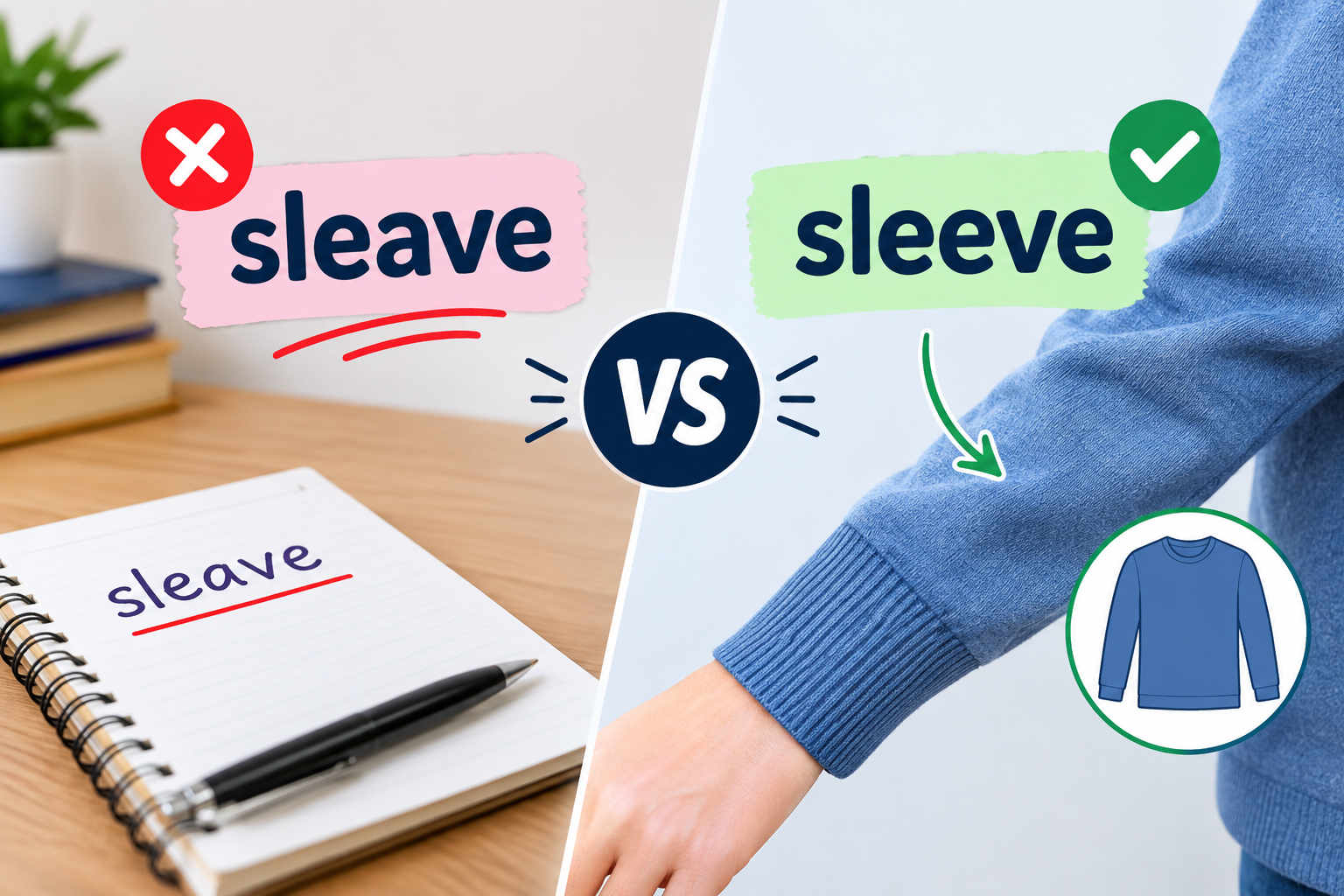
If you’ve ever paused mid-sentence wondering whether you need an “a” or an extra “e” in that word describing the part of a shirt that covers your arm, you’re not alone. The sleave vs sleeve confusion trips up even confident writers, largely because “sleave” looks like a simple misspelling of “sleeve” but is actually a real, if rare, English word with its own distinct meaning. Understanding the difference between these two terms will help you avoid an embarrassing typo and, as a bonus, teach you a fascinating little corner of English vocabulary that most people never encounter.
The Short Answer
In the vast majority of everyday writing, sleeve is the word you want. It refers to the part of a garment that covers the arm, as well as several extended meanings (a protective covering for a record album, a hollow cylindrical part in mechanics, and so on). Sleave, on the other hand, is an archaic and obscure noun and verb related to silk thread and the act of separating fibers. Unless you’re writing historical fiction, poetry, or discussing textile history, you almost certainly mean “sleeve.”
What “Sleeve” Means
“Sleeve” is the everyday, high-frequency word. It comes from the Old English “slīef” or “slēf,” and it has held essentially the same core meaning for centuries: the part of a piece of clothing that covers the arm. From there, the word has picked up several figurative and technical uses:
- Clothing: “She rolled up her sleeves and got to work.”
- Idiom: “To have something up your sleeve” means to have a secret plan or resource in reserve.
- Records and media: A “record sleeve” or “album sleeve” is the protective cardboard or paper cover for a vinyl record.
- Mechanical/technical: In engineering, a “sleeve” is a tube-shaped part that fits around another part, such as a “sleeve bearing” or “cable sleeve.”
- Food and retail: A “sleeve” of crackers or cups refers to a tube-shaped packaging unit.
Because “sleeve” appears constantly in daily conversation, clothing descriptions, product listings, and casual writing, it’s the spelling your spellcheck expects and the one that will almost never be wrong in a modern context.
What “Sleave” Means
“Sleave” is where things get interesting. Historically, “sleave” refers to a knotted, tangled, or unworked silk thread, especially the soft, filmy silk used in embroidery before it’s twisted into stronger thread for weaving. As a verb, “to sleave” means to separate or divide threads, particularly to untangle raveled silk.
The word shows up famously in Shakespeare’s Macbeth, where sleep is described as something that “knits up the ravell’d sleave of care” — a poetic image comparing sleep’s restorative power to the untangling of knotted silk thread. This single, celebrated literary reference is probably the main reason “sleave” survives in dictionaries at all; outside of Shakespearean scholarship, textile history, and specialized poetry discussions, the word has essentially vanished from everyday use.
So when you’re weighing sleave vs sleeve in a piece of writing, ask yourself: am I talking about arms, clothing, packaging, or mechanical parts? Then “sleeve” is correct. Am I discussing silk threads, embroidery history, or quoting classic literature? Then “sleave” might be the word you actually need — though even in those specialized contexts, it’s worth double-checking your source material, since the word is so uncommon that many writers misuse it or avoid it altogether.
Why the Confusion Happens
The sleave vs sleeve mix-up is a classic case of what linguists call an “orthographic near-miss” — two words that look almost identical on the page but diverge in meaning and usage frequency. A few factors drive the confusion:
- Visual similarity: The words differ by only one letter and a swapped vowel pair (“ea” versus “ee”), which is an easy typo to make, especially when typing quickly.
- Rarity of “sleave”: Because “sleave” is so uncommon, most people have simply never seen it in print. When they encounter it, their brain autocorrects it to the familiar “sleeve,” reinforcing the idea that “sleave” must be a mistake.
- Homophone-adjacent pronunciation: While not true homophones, the two words sound close enough in casual speech that listeners transcribing spoken words might default to the wrong spelling.
- Spellcheck limitations: Ironically, because “sleave” is a legitimate dictionary word, spellcheckers won’t flag it as an error even when a writer meant “sleeve.” This means the sleave vs sleeve error can slip through automated proofreading entirely.
Quick Tips to Remember the Difference
If you want a simple mental trick to settle the sleave vs sleeve question once and for all, try these:
- Think “sleeve” = “arm.” Both words contain a double “e,” just like the everyday concept they’re most associated with (a sleeve covers your arm, and “arm” and “sleeve” both feel common and concrete).
- Associate “sleave” with “silk” or “Shakespeare.” Both “sleave” and “silk” start with the letter S and belong to the world of textiles and classic literature — a useful memory hook for the rarer word.
- When in doubt, choose “sleeve.” Statistically, if you’re writing about clothing, technology, food packaging, or almost anything in modern life, “sleeve” is overwhelmingly more likely to be correct.
- Run a mental context check. If your sentence has nothing to do with thread, weaving, or antique poetry, you don’t need “sleave.”
A Simple Sentence Comparison
To cement the distinction, compare these two sentences:
- “He pushed up his jacket sleeve to check the time.” (correct, everyday usage)
- “The embroiderer carefully untangled the sleave before threading her needle.” (correct, specialized/historical usage)
Swapping the words in either sentence would sound immediately wrong to anyone familiar with the terms, which underscores why the sleave vs sleeve distinction, while narrow, still matters for precision and credibility in writing.
Final Thoughts
The debate over sleave vs sleeve isn’t really a debate about correctness so much as a question of context and frequency. “Sleeve” is the word nearly everyone needs, whether discussing fashion, mechanics, food packaging, or common idioms. “Sleave,” meanwhile, is a beautiful but nearly extinct term tied to silk threads and literary history, most famously immortalized by Shakespeare. Keeping this distinction in mind will help you write with confidence and avoid an easy, if uncommon, spelling slip.